The Bulletin · Hardwater 101 · Sep 16, 2026
Congeners and Hangovers: Why Some Drinks Hurt More Than Others
What congeners are, why bourbon hurts more than vodka the next morning, what actually causes a hangover, and which drinks carry the fewest of them.

If you have ever had two beers on a Friday and felt fine, then had two glasses of red wine on a Saturday and woken up feeling like you had been in a car accident, you already know the thing this essay is about, you just might not know that the word for it is congeners. Congeners are everything in an alcoholic drink that is not ethanol and not water, the trace compounds that come out of fermentation, distillation and barrel aging, and they are the main reason two drinks with the exact same amount of alcohol can leave you feeling so different the next morning. It is also the idea this whole company was built on, so we have opinions.
One thing up front. How much you drink matters far more than what you drink, every study below says so, and we are not going to pretend otherwise. But once you have settled how much, the what still moves the needle.
What a congener actually is
When yeast turns sugar into alcohol it does not make ethanol and nothing else. It also makes small amounts of other alcohols (methanol is the famous one, plus the heavier ones people call fusel alcohols), aldehydes, esters, acids, ketones and a long tail of other compounds. Distillation concentrates some of those and strips out others depending on how carefully it is run, and then a barrel adds a whole second layer of tannins, wood sugars and colored compounds over the years a spirit sits in it. All of that together is the congener load. It is what gives a bourbon its caramel and smoke and a red wine its body, so congeners are not bad in some moral sense, they are most of the reason anyone pays for a twelve year old anything. They are also work for your body to do on top of the ethanol.
The best known study on this, out of Brown University in 2010, measured the two spirits it was comparing and found the bourbon carried about 37 times the congeners of the vodka. Methanol in particular tends to run highest in red wine, brandy and whiskey and lowest in beer and vodka.
What the studies actually found
Two experiments get cited everywhere, and it is worth knowing what they actually did.
The first one goes back to 1970, when a researcher named Loring Chapman ran what were basically controlled parties, 91 moderate drinkers in groups of four to ten, and gave them measured doses of bourbon or vodka cut with water, with the food and the timing controlled. At the higher dose, 20 of the 30 bourbon drinkers reported a definite hangover against 13 of the 30 on vodka, and the severe hangovers are where it really split, 10 people in the bourbon group and 1 in the vodka group, on the same amount of ethanol.
The second is the Brown study, led by Damaris Rohsenow and published in 2010 in the journal Alcoholism: Clinical and Experimental Research. Ninety-five healthy young adults between 21 and 33 drank bourbon or vodka to a breath alcohol of about 0.11 on one night and a matched placebo on another, and then got tested in the morning. The bourbon hangovers were rated worse. The part that gets left out of every listicle is that next day performance on the attention and reaction tasks was impaired just as badly either way, so congeners change how bad you feel and they do not change how impaired you are, and vodka is not a free pass to drive to work in the morning, it just hurts less. Rohsenow’s own review of the whole literature that same year put it plainly: bourbon hurts more than vodka, and the ethanol itself still matters considerably more than the congeners do.
The ranking
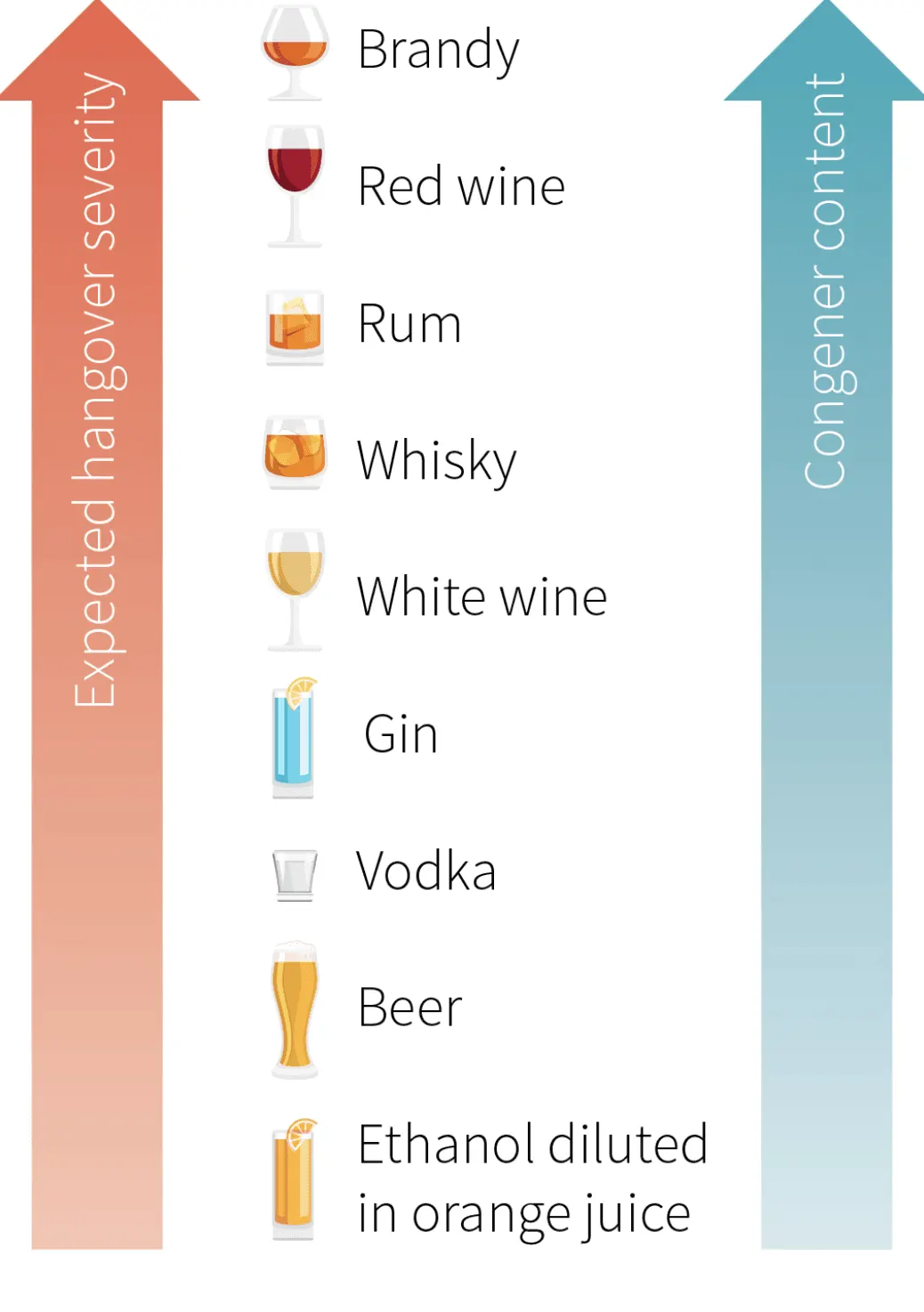
If you line the drinks up by congener content and expected hangover severity you get roughly this, easiest first: ethanol diluted in juice, then beer, vodka, gin, white wine, whiskey, rum, red wine, and brandy at the top. That is the order Andrew Huberman walked through on his alcohol episode (number 86 of the Huberman Lab podcast, the one half of San Diego seems to have listened to), and the shape of it comes from a 1973 trial by a researcher named Pawan who got twenty volunteers drunk to the same blood alcohol once a week on a different drink each time. Brandy was worst, then red wine, rum, whisky, white wine, gin, vodka, and plain ethanol in water was easiest, with vodka and the plain ethanol producing nothing more than a mild headache in a couple of people. His point, and ours, is that this is not about sugar. People blame the sugar in a margarita or a rum and coke for the next morning, but a brandy has no sugar to speak of and it sits at the very top of the list.
Two notes on that list. Beer sits low on congeners, but it is five percent alcohol in a big glass and people drink a lot of glasses, and volume beats everything else on the chart. And the “ethanol diluted in juice” entry at the bottom is not a joke or a hypothetical, it is what the old trials actually poured, a neutral spirit cut into water or juice, and it came out easiest every time. We stared at that entry for a long time before we started this company.
Why does tequila hurt less
We get this one a lot. The honest answer is that nobody has run the bourbon versus vodka experiment on tequila, so anything we say is inference, but the inference is reasonable: a blanco is unaged and clear, so it ought to sit toward the vodka end, and an añejo has spent a year or more in a barrel picking up the same kind of wood compounds that put whiskey where it is. The bigger factor is probably how people drink it. Two neat pours of a good blanco over dinner is a very different night from a pitcher of margaritas made with a well mixto and sour mix, and the second one is the hangover, not the agave.
What is actually happening the next morning
Congeners are one ingredient in a hangover, not the whole recipe. The National Institute on Alcohol Abuse and Alcoholism lists the pieces: mild dehydration, sleep that was worse than it felt, an irritated stomach lining, inflammation, and the acetaldehyde your liver makes as it breaks ethanol down. Congeners stack on top of all of that. Dehydration turns out to be the part everybody overrates. A 2024 review by Joris Verster’s group at Utrecht went back through the evidence and concluded that a hangover and dehydration are two separate things that happen at the same time, that drinking water during the night had only a modest effect on the next morning, and that drinking it the next day did not change how bad the hangover was. Drink the water anyway, it slows you down, but it is not the fix your uncle told you it was.
What the research keeps coming back to is the ethanol itself, how much of it, how fast it went in, and how your particular body clears it. Congeners are the one layer you can actually choose before the night starts.

What you can do with this
If you know two drinks will get you to the same place and one of them is carrying thirty times the byproducts, you pick the other one on a night when tomorrow matters, and that is most of what there is to it. For us it looks like clear over dark on a work night, wine with dinner and not after it, and a neutral spirit with something real mixed into it when it is a long afternoon rather than a big night. The wider version of that filter is in the clean drinking guide. And none of it replaces drinking less, which is the boring answer and the true one.
Why we built a drink at the bottom of the chart
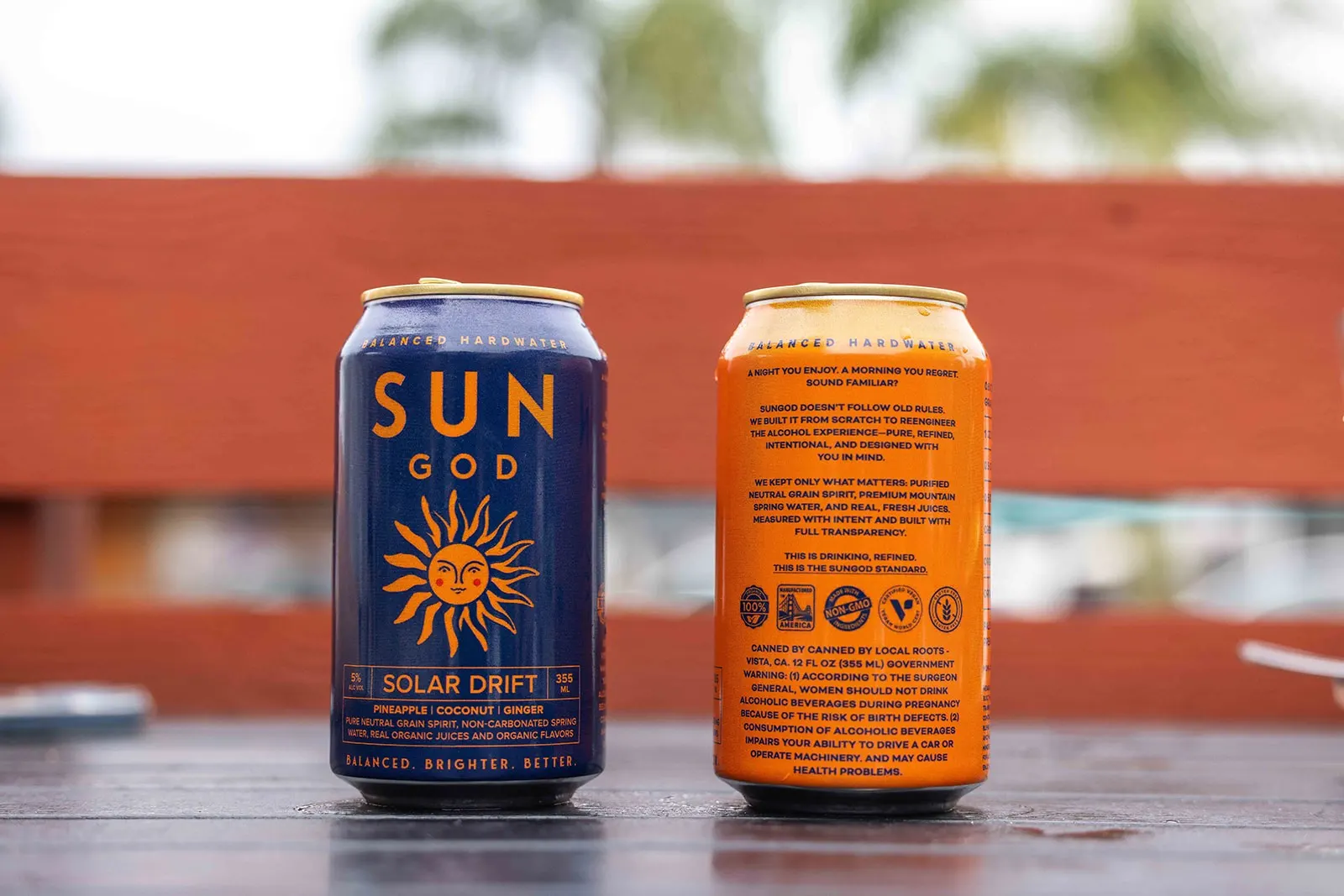
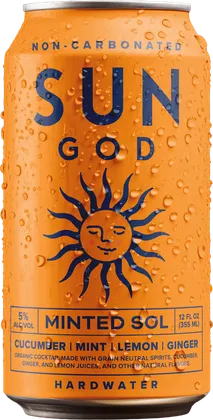
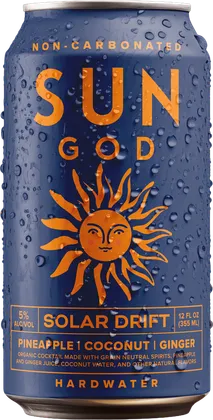
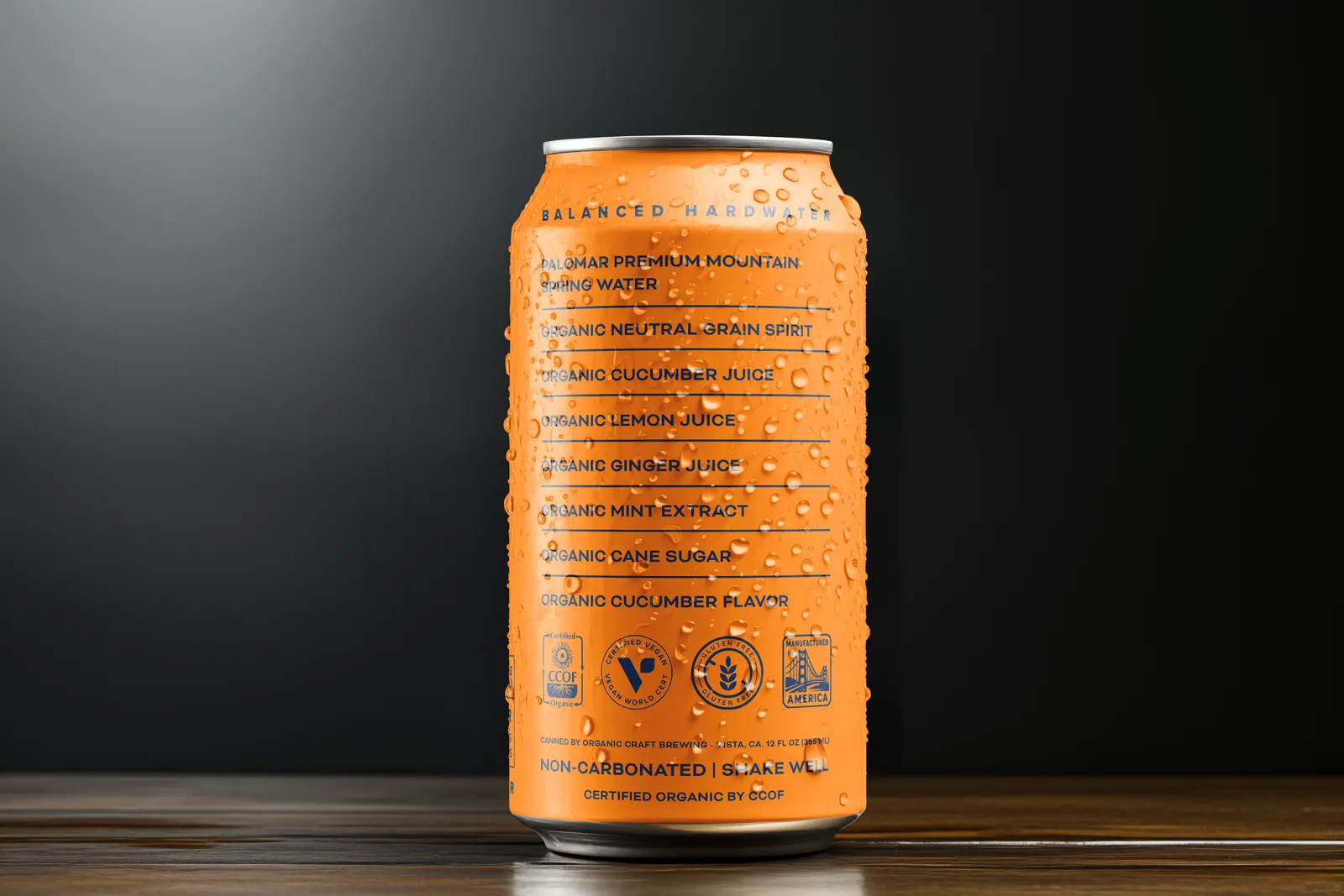
Our founders read that ranking, saw plain ethanol in juice sitting at the bottom of it, and thought, that is a drink, why is nobody making it well. So SUNGOD is built on an organic neutral grain spirit, which by federal definition is ethanol distilled at or above 95 percent alcohol, about as close to zero congeners as a legal drink gets, cut down to 5 percent with Palomar Mountain spring water, real organic juice and a little organic cane sugar, with no carbonation. The long version of why the spirit matters is in our neutral grain spirit explainer, the whole build is laid out in the whitepaper, and what a Hardwater is covers the category. We are not promising you a morning. Five percent is five percent, and if you drink eight of them you are going to feel eight drinks. We took out the part of the drink the studies point at, printed everything that was left on the side of the can, and stopped there. The panel is on the back, and the locator has the shops that carry it.
Questions people ask
01 What are congeners in alcohol?
Congeners are the compounds in a drink other than ethanol and water, the methanol, fusel alcohols, aldehydes, esters, tannins and the rest that come out of fermentation, distillation and barrel aging. They are most of what gives a whiskey or a red wine its flavor and color, and they are also extra work for your body on top of the alcohol itself, which is why two drinks with the same ethanol can feel so different the next day.
02 Which alcohol has the most congeners?
Brandy, red wine, rum and whiskey sit at the top, and the best known trial found bourbon carried about 37 times the congeners of vodka. Dark, aged and full of character is the pattern. Barrel time adds a whole second layer of compounds on top of what fermentation left behind, which is exactly why those drinks taste the way they do and why they tend to hurt more the next morning.
03 Which alcohol has the fewest congeners?
Vodka, gin and beer are at the low end, and a neutral spirit distilled to 95 percent alcohol and cut back with water or juice is lower still, which is where the old studies found the mildest hangovers. Clear is a decent rule of thumb but not a guarantee, since some clear spirits, silver tequila for one, can carry more than their color suggests.
04 Do congeners cause hangovers, or is it just the alcohol?
Mostly the alcohol. Every controlled study found that how much ethanol you drank was the biggest factor by a wide margin, and congeners made a real but smaller difference on top of it. In the 2010 Brown University trial the bourbon drinkers rated their hangovers worse than the vodka drinkers at the same breath alcohol, but their next day reaction times were impaired just as badly either way.
05 Does drinking water prevent a hangover?
Not really, and that surprised us too. A 2024 review from the hangover researchers at Utrecht went back through the evidence and concluded that dehydration and hangover are two separate things that happen at the same time, that water during the night had only a modest effect on the morning, and that water the next day did not change how bad it was. Drink it anyway, it is good for you, just do not expect it to fix anything.
The bottom of the chart
Built from the low end of that list
Neutral grain spirit, spring water, real juice, no bubbles. The ingredient panel is printed on the can if you want to check our math.